The camera can make or break any user experience with a game. It is the way in which they will see everything a game offers.
Video games have long used cameras to varying degrees of success and effect. Whether the top down view of a Command & Conquer game to shooting down hordes of Covenant forces through the eyes of Master Chief in the Halo series, most games use cameras. Many early examples of games back in the 80’s like Zork didn’t however, offering a simple text adventure. This can easily be attributed to the limited ability of computers of the age and Infocom’s desire to utilise as much space as possible in creating a huge and enjoyable adventure. However, games would not be allowed to get away with that, needing a camera even for a game similar to Zork in nature and presentation. Making one for an arena shooter is obviously needed too and so, choosing the right kind of camera for the job will be paramount in making the best UX practice for this project. It is a simple addition to any game but well thought out design of such a mechanic, albeit simple, will make a massive different to performance.
An excellent analysis of the use of cameras in games is the below talk from GDC 14 on 50 Game Camera Mistakes, exploring the issues of games using the wrong cameras in many situations.
In this talk, John Nesky refers to the three main types of camera that you can expect in a videogame:
- Fixed-angle Third Person
- Dynamic Third Person
- First-Person
Many games use variations of the way in which these three camera types work, for example the Devil May Cry games (prior to Ninja Theory’s reboot) used a different fixed-angle camera to that of the StarCraft series, for example. In the DMC games, the camera was fixed in place but moved it’s angle accordingly based on the location you were in and what angle it need to move by however, the user had no control over it directly, it was all through second-stage interaction. In StarCraft, the camera can be zoomed in and moved on an x and y-axis but it’s angle is always fixed. Each camera type works for it’s genre and usually sticks with any game in these genres due to previous titles using them and the convention that brings with it. So therefore, third-person arena games are also going to have their own variation on convention and choosing, or designing, the right one for my game will be essential.
Third Person Viewpoint Games
Before looking specifically at the arena game genre and the cameras used there, let’s look on broad terms and narrow down. Games that implement third person cameras from outside of the genre can offer insight into design choices that looking explicitly at arena games might not provide. As quoted in Macklin and Sharp’s 2016 book, ‘Games, Design and Play‘; “Genres can limit thinking, leading us to think in terms of what play experiences we want to borrow or improve instead of the play experiences we want to provide our players.” With this in mind, I’ll be taking a look at an exemplary game that worked in third person is the 2005 critically acclaimed (and widely considered best survival horror game of all time) Capcom game Resident Evil 4.

Screenshot provided by videogamer.com – NB: Taken from the 2014 HD remaster
Prior games in the Resident Evil franchise had, for almost every game, used a fixed point camera angle for each room or area, with larger areas using multiple cameras so that the player can stay in view (a design choice that stuck through to the Devil May Cry franchise due to it’s Lead Producer being involved with RE1 as well as being involved in the initial development of RE4). It was a design choice that worked well for the franchise however, with changing trends in what gamers wanted, it was becoming archaic. The drastic decision to reinvent the wheel and make the game a third person one that performed behind the shoulder of the protagonist changed the way in which many future third person games would mechanically function practically overnight. It was innovative and cleverly designed. For a survival horror game, it turned everything on it’s head and changed how people would experience Resident Evil until the recently released (and once again reinvented) Resident Evil 7.
Many games have taken this viewing angle for their games since, such as Gears of War and Warframe though there are slight variations, such as the distance away from the character, the FOV or the move speed.
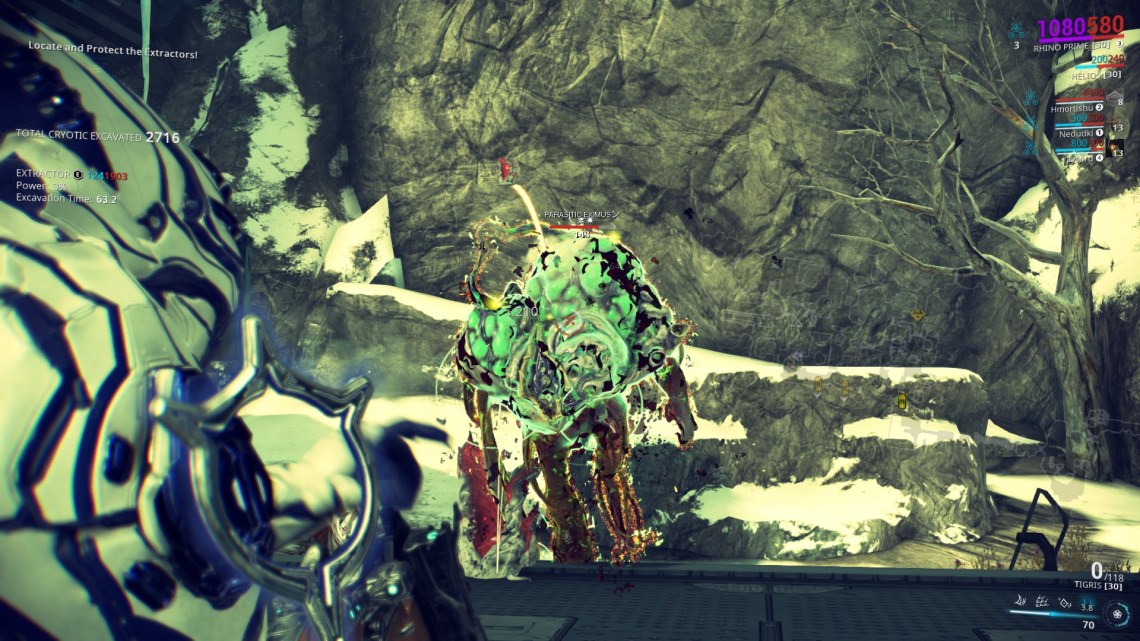
Combat during a mission in Warframe
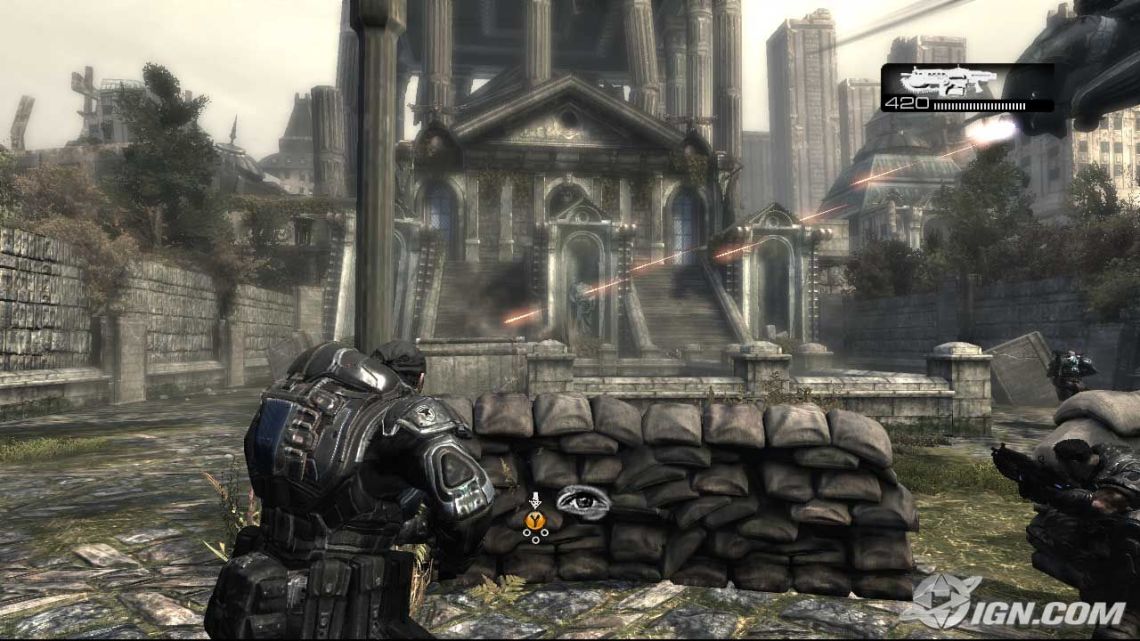
Camera angle used during play in Gears of War. Source here
While both Warframe and GoW do not use exactly the same constraints used by RE4, you can see the influence it has had on future 3rd person games since, incorporating the closer over the shoulder angle with the character slightly off centre to the left and even more so when using aiming mechanics to zoom in. With the protagonist not being directly in the centre of the screen, the action can take their place, enemies can easily be spotted without having to look too far around the screen, everything is focused on the central point of the screen. Taking this into consideration through the use of arena games, everything should be instantly visible for fast paced arena action. Taking this camera angle, specifically for third person, works much better than keeping the player character in the middle all of them time.
Arena Shooter Game Cameras
Arena Games have slowly dwindled in popularity since the release of 7th Gen consoles back in the mid 2000’s. There are still some games that follow their conventions that are released, such as Monday Night Combat, but the heyday of Doom, Quake and Unreal Tournament had passed. Recently, there has been a resurgence in these franchises, with DOOM being rebooted as of last year, Unreal Tournament is coming as a free release through Epic Games, currently in development, and Quake is being revealed slowly before release.
From a design standpoint, as well as to accommodate for the varied hardware of PC users at release, games like Quake and Doom used a first person perspective. As well as lowering the load on the computer, players are put straight into the fight as though they are the nameless soldier they play as by playing through their eyes. This makes the only thing that gets in the way of the action whatever weapon you are currently wielding and the UI.

Quake Live Screenshot. Source
By removing the body of the player from their view, much more of the screen opens up for the environment and other players within it. This makes focusing on important elements easier to deal with, players become more focused on the actual gameplay. As a remake of one of the original games of the genre, let’s take a look at a later release of a similarly premised game; Halo 3.
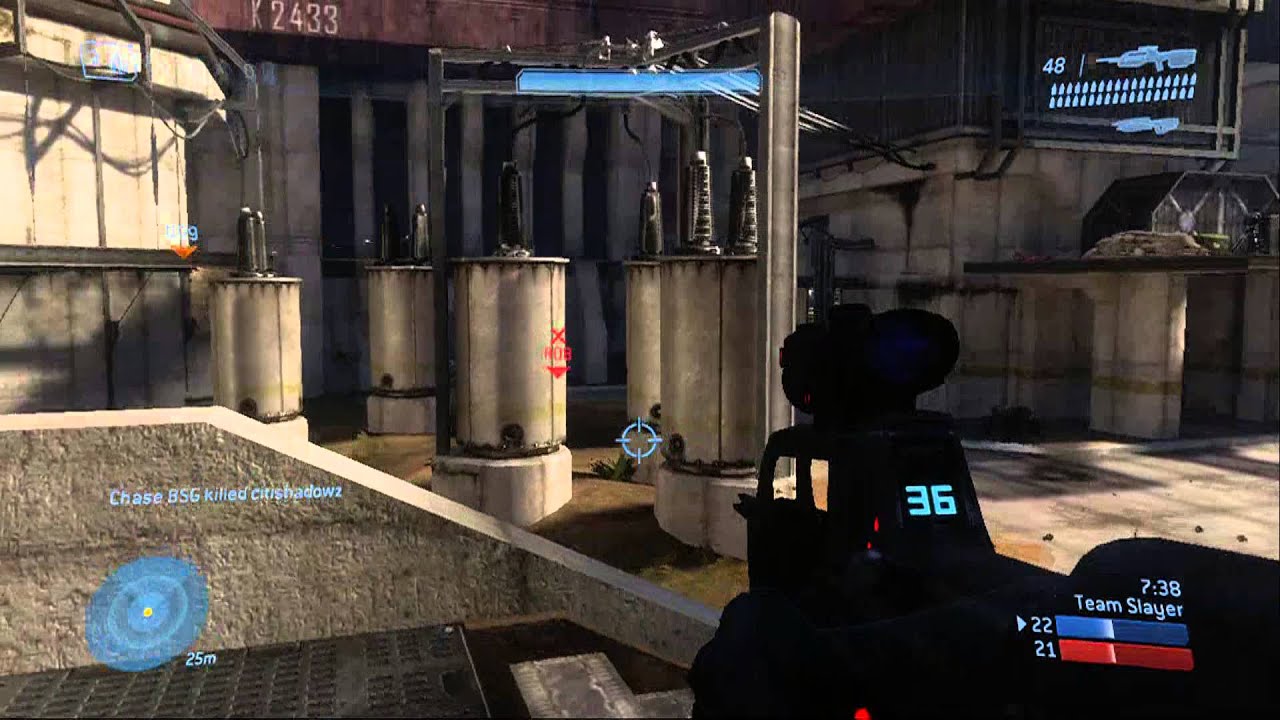
As a game initially released in 2007, there are changes to the appearance of gameplay that come from natural evolution. For starters, Halo’s Battle Rifle has a much larger presence on the screen over Quake’s rocket launcher. The UI also has elements spread across the screen and include the addition of a sonar-like map. Team scores are displayed with a graphic, not just numbers and, due to reload mechanics, displayed the weapon and ammo count for the weapon being used in the top right. The UI is still minimalist and takes up as little of the screen as possible whilst also being spaced evenly around the whole screen. By making the most of the screen and minimising space at each part, all important information can be displayed in the areas player are likely to look at (the top half of the screen) with the less frequently updated team score displayed in an area that players won’t focus on all the time (it should be noted however that as all weapons are held in the right hand, they create a dark background that makes the scoring system stand out more, making the experience of viewing scoring easier).
These games, however, are first person so looking at how a third person game of a similar nature should also be considered. Enter Super Monday Night Combat.
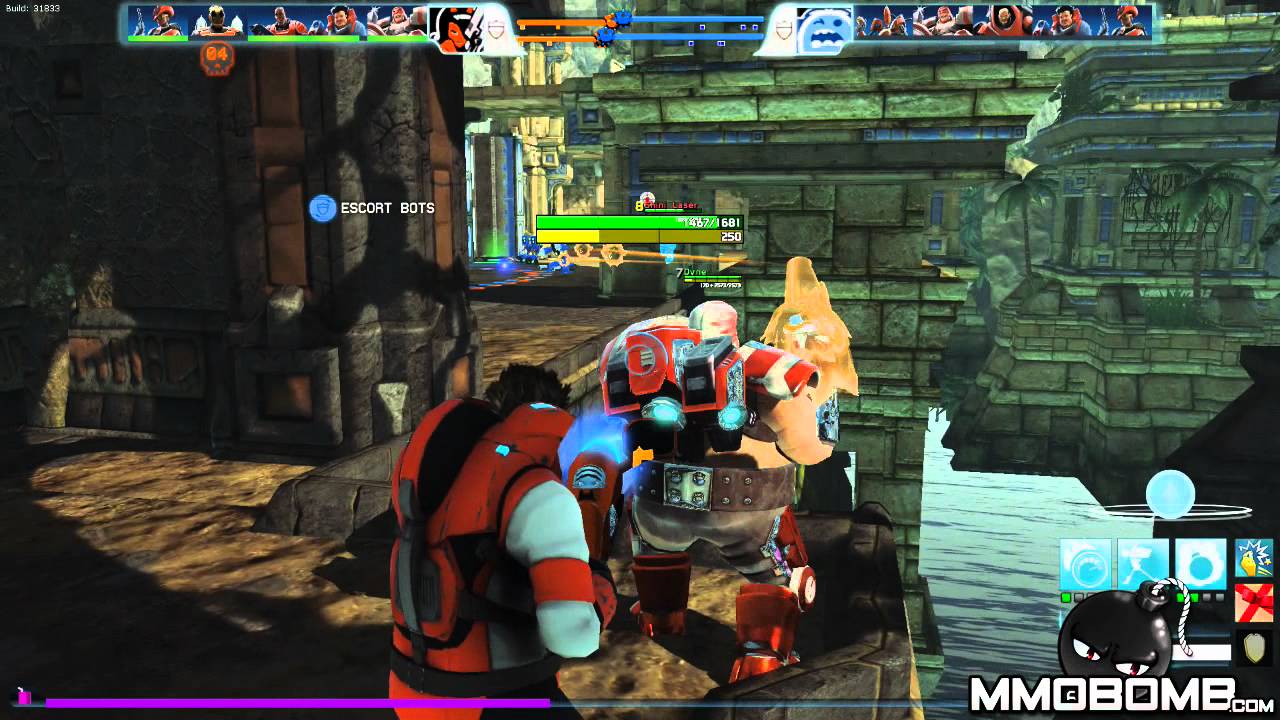
Source – MMOBomb.com Youtube Video
Super MNC (SMNC) is a 5v5 arena game utilising varied maps to create a televised deathmatch experience. As a game akin to Quake and Halo Multiplayer, SMNC uses older examples to create a similarly designed UI to make overall UXD practice familiar: minimalist, elements are placed around the screen, information is consise. The only addition that comes from this is the inclusion of the player being front and centre. The camera is placed so that the player is very slightly off centre to allow for the gun to line up with the aiming reticule in the centre of the screen. This approach can indeed work for a third-person arena game however, I believe there to be issues with SMNC’s camera position. Taking principles of dynamic third-person camera design, movement around the character can create problems such as moving into terrain making the player invisible (if this isn’t addressed properly) as well as issues that come from ineffective aiming (along with zoom in issues if this is a mechanic in any game of this kind).
Camera Choice
So what do I believe would work best for my premise? The Resident Evil 4 approach: a close-up, over the shoulder camera. Why? For reasons regarding the camera of SMNC, issues regarding zooming involve less camera movement, making faster animations as well as a more reliable method of implementation. Having the camera at a fixed angle would also make overall cohesiveness more fluid, the character can’t shoot unless they are looking at the enemy so why implement a camera that can look behind the character without also turning them? An extension of going beyond this simple setup could also be explored as evidenced in another RE game, RE6, where the inclusion of a sliding mechanic allowed the instant turning of a player on their back, forcing the camera to move instantly with the player. Beyond the scope of the project but still, a consideration nonetheless. Alternatively, implementing the camera controls (as well as overall mechanics) of Umbrella Corps, Resident Evil’s lacklustre attempt at an arena type eSport game, would be a very poor route to take in general and as such, striking a balance between the slow approach of RE4 and the fast paced direction it took with Umbrella Corps should be considered.

 Aaron Swiss-Hamlett