If you’re of a certain age, it’s the game that got everybody banned from playing games on the school computers until you found the loophole that was Cool Math Games. Today, it’s one of the longest lasting MMO games on the market.
Runescape has existed for 25 years with varying degrees of popularity. It still maintains a healthy player base that would make most attempts at modern live service games incredibly jealous.
There are many factors for it’s popularity, such as nostalgia, the ability to play it on both mobile and computers, sunk cost mentality for long time players, a relatively relaxed nature of general gameplay and how much it stands out from any other game on the market to name a few.
One thing that is clear when playing it is how the game involves a much more in-depth set of questions and choices that players will make about decisions pertaining to progression. RuneScape is a game that is more like a sandbox than a strict path in which players need to take. No questline has to be completed unless the player chooses to complete them. Many quests offer some form of unlock, such as a new region, a teleportation method or location or access to a new feature or resource. Additionally, these may also require the player to have specific Skill levels to access or utilise. This means that players could access any piece of content at any time, at their own pace. The only thing that stops them from accessing anything is their decision making on how soon they want to experience it.
Decision Factors
There are 8 identified factors that determine decision making in RuneScape. These are:
- Skill Progression Speed
- Profitability
- Direct/Indirect Progression
- Interaction Intensity
- Pre-Requisites
- Capital
- Future Content Accessibility
- Fun & Enjoyability
Skill Progression Speed
This factor is the choice of how fast a player wants to earn XP in a Skill. This may mean choosing the option with the highest available instance of XP per action taken or it might mean choosing the option that has a high interaction intensity to it i.e. Actions Per Minute (APM) but with a lower XP value per action and a higher Experience Points Per Minute (EPM) due to the increased rate at which the actions are completed.
For those looking to reach Level 99 in a Skill in the fastest time upon starting a new account, it is likely that skill progression will utilise more active and interaction intense methods than those which are less intensive i.e. AFK viable actions.
Profitability
This factor is the choice of how quickly a player can earn money. This can involve Skilling, Combat, collecting items in the environment or buying items from stores. A majority of the time, this will involve selling items on the Grand Exchange, RuneScape’s in-game auction house. For Ironmen accounts, ones with restrictions, they cannot use the Grand Exchange. This means that any decision made primarily on profitability has to remove this option as a viable strategy.
Many of the strongest profitability options with low Pre-Requisite factors tied purely to Skilling tend to have very low XP Rates as a balancing offset so that the option does not become to singularly overpowered and the only thing that players perform to progress. Late game options with high Pre-Requisite factors, such as smelting bars at the Blast Furnace for Smithing or Fletching’s higher tier Bows offer decent XP rates and decent profitability rates.
Direct/Indirect Progression
This factor is the choice of progressing elements of their account directly, performing actions progressing that element or indirectly, such as obtaining mob drops that relate to a skill. Some skills are very costly endeavours, notably the Construction Skill. There’s no direct method of profiting from it, only indirect ones such as creating Teleport Tablets via the Lectern in the Player Owned House. Therefore, making tablets provides money which indirectly provides progression to Construction since this money could be used on resources pertaining to the Construction Skill.
For players wanting to progress to endgame content or to simply obtain Level 99 in a skill, these decisions will occur regularly. A potential loop of buying resources and then performing profitable actions will likely take over as part of account progress, diminishing the amount of times this factor crops up but the presence of this factor’s influence on decision making will be ever present.
Interaction Intensity
This factor is the choice of how much and often the player wants to interact with the game to progress their desired goal. Typically considered when focusing on Skilling Progression or Profitability Factors, players could simply choose to perform actions that are AFK-able whilst doing something else outside of the game (the concept of Second Monitor Content) or they could actively participate in gameplay by choosing more intensive activities. This could be more active Skilling methods, taking part in minigames or taking on combat encounters that provide a challenge such as higher level monsters or Raids.
Pre-Requisites
This factor is the choice of deciding what to do based on what pre-requisite criteria the player has already met in order to participate with that content. Many locations, features and some equipment require players to complete a quest or questlines in order to unlock them. Many items require a player to have reached appropriate levels in Skills in order to use them. These may require a considerable time investment, in the case of Skill requirements and questlines, leaving players to take opportunities that can be reached more quickly. This factor become less important to players who have already reached appropriate late game Skill Levels, completed many quests and/or obtained many items enabling content access or improved functionality of it.
Capital
This factor is focused on what content a player wants to perform based on how much gold they currently have. Some Skilling methods require a considerable amount of gold to even start performing consistently or efficiently. Endgame combat content usually requires some of the most expensive items in the game to even have a chance of completing. This leads to taking options that might be less optimal for character progression but at least achievable when in the early to mid-stage of a player’s account. Some decisions may forego this factor entirely, such as performing gathering type skill actions, e.g. mining rocks, cutting wood, fishing.
Future Content Accessibility
This factor is focused on what content a player wants to perform in the future and how their current actions will help them access it, typically as quickly as possible. This may be a higher tier of item in a Skill, new combat gear, minigames, quest requirements, etc. This is usually an all encompassing decision that is made by anyone who has not reached the endgame state, i.e. players without Level 99 in all skills, outstanding quests, achievement diaries and minigame reward sets.
This will be an ever present factor for non-endgame players. It will only become a non-factor when a player has spent hundreds, if not thousands, of hours playing the game.
Fun & Enjoyability
Above every other factor, this is the most important in the context of a video game. If the player is not having fun, what is the point of doing anything within it? Regardless of the efficiency or profitability of an action, it fundamentally needs to be fun for the player in the moment. Runescape, if committed to, requires the repetition of actions totalling in the hundreds of thousands. If a player is going to play it for as long as they take, they need to be able to enjoy the journey. Sometimes a decision may be made that isn’t fully at the behest of fun, such as for making progress to future content, but it should still be at least somewhat worthwhile in the moment or feel like it will lead to more fun in the future.
Example – Mithril Bar Creation
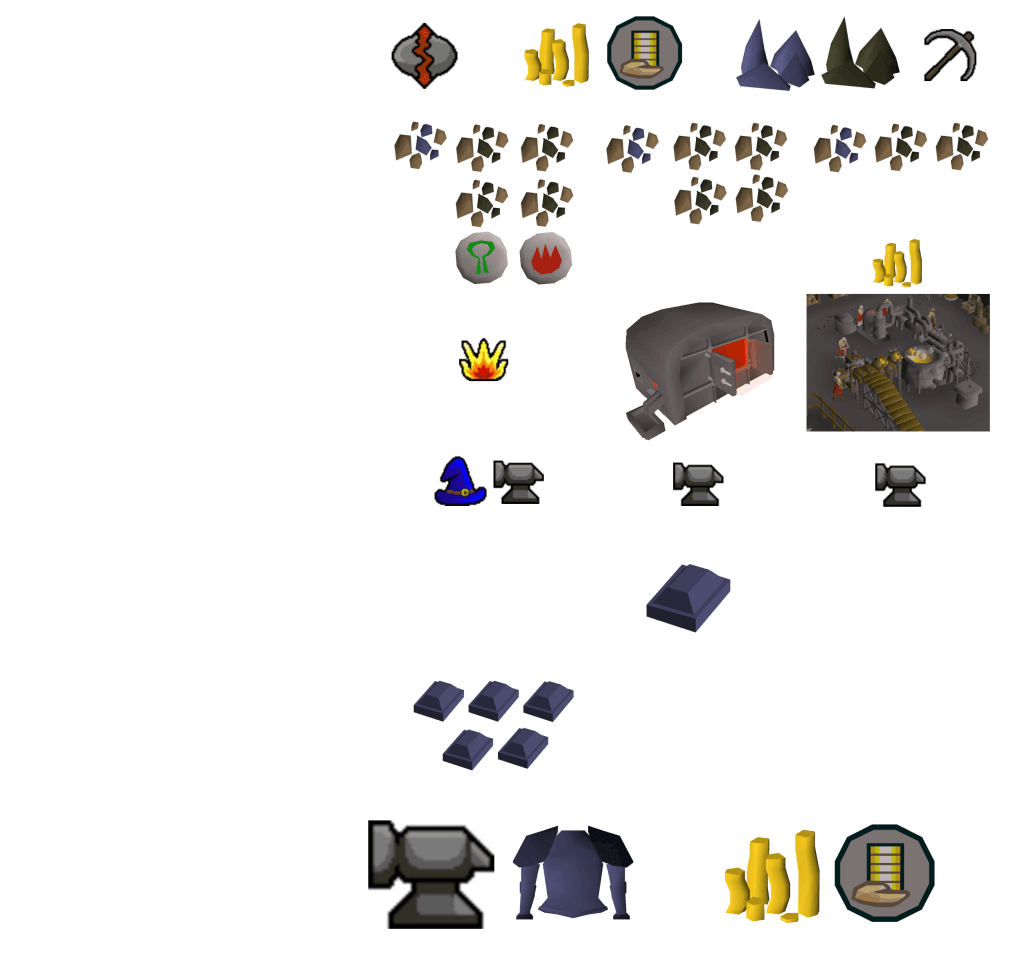
To showcase this decision making in action, the use case for creating a Mithril Bar will be utilised.
The above image shows the steps in which to create a Mithril Bar and then common uses for the bar after creation.
There are 3 variations of the same method of creating a Mithril Bar. Each involves the process of smelting 1 Mithril Ore with some Coal. The methods, from left to right, are:
- Superheat Item Spell
- Normal Furnace Creation
- Blast Furnace Creation
The process will always involve a Creation Method. Obtaining the resources is dependent on the method and which Decision Factors the player has in mind. If a player is on an Ironman account or wants to use the least capital possible, such as when they don’t have much to begin with or to maximise profitability at the cost of skill progression speed, they will obtain the resources directly from their sources. This means they must fulfil the pre-requisites for obtaining the resources before utilising this method.
Mithril Ore and Coal are obtained via the Mining Skill, requiring a level of 55 and 30 respectively. If the player wants to use the Superheat Item spell they will need Nature and Fire Runes obtained via the Runecraft Skill, requiring a level of 44 and 14 respectively, whilst also obtaining the Rune or Pure Essence from the Rune Essence Mine available after the completion of an early game quest. They will also need level 43 in the Magic Skill. Since players would need to be Level 44 for Nature Runes, they will naturally be able to create Fire Runes. However, if the player has an equippable fire magic item, such as a Staff of Fire, they can avoid this requirement as the item will grant unlimited runes of the element when equipped. While this will take some time to achieve beforehand, once available, it will always provide a solution of obtaining resources for no monetary cost but with opportunity costs in other factors such as profit per hour.
If a player wishes to focus more on the profitability per hour and raw skill progression speed of their Smithing Skill and have the initial capital, one might go to the Grand Exchange and obtain the resources that way. Taking out the need for the Runecraft and Mining Skill requirements, any of the Creation Methods will now only require a Smithing level of 50 with the Superheat Item method still requiring level 43 Magic.
Next comes the Creation Method itself. Each method offers different Decision Factors to the player. Below is a table of the pertinent data for each Creation Method:
| Superheat Item | Standard Furnace | Blast Furnace | |
| Action Time (Game Ticks/Seconds) | 3/1.8s | 4/2.4s | 11/6.6s[1] |
| Action Intensity | High | Low | Medium |
| Profitability Per Item | Low | Medium | High |
| Profit Per Hour | Negative/Low[2] | Medium | High |
| XP Earned | Magic & Smithing | Smithing | Smithing |
- [1]. It is possible to create up to 28 of any Bar at once in any Blast Furnace action. As such, this can remove up to 27 action instances that Superheat Item and Standard Furnaces cannot. There is also movement and bank interaction that must be taken into account, adding on a non-zero but variable amount of time in addition to the one listed here. The time listed is specifically for the action of the Blast Furnace generating the Bar once enough resources to make at least 1 Bar is added.
- [2]. If Resources have been obtained at source, the profitability per hour for Superheat Item would likely be higher than the Standard Furnace method as it is 25% quicker per action to perform. At current Grand Exchange rates, the Superheat Item method is actually unprofitable
Using this table, players may want to progress both their Magic and Smithing skills at the same time and utilise the Superheat Item method but be required to perform the most interactions in order to do so. If a player wants to progress in a less intense manner, the Blast Furnace requires attention but far less actions to achieve the same goal and provides only Smithing XP. If a player wants to be relatively AFK in their play style, they can use a standard furnace. This means there is a play style for any player’s situation and they will be rewarded for their level of effort in different ways dependant on their goals.
Each method will generate at least 1 Mithril Bar, with the Blast Furnace being able to generate up to 28 bars in 1 action if the correct setup has been made prior to the action. Now, the player is able to take their Mithril Bar and utilise it further, once again based on which Decision Factors they are taking into account at the time.
If the player wanted to make efficient Smithing Skill progress after the creation of their bars, they would likely choose to create items with the highest amount of bars needed to make it in 1 action at an anvil. Each bar linearly provides Smithing XP per item created so the higher the bar count, the more an item creation action makes. Therefore, if they have the appropriate Smithing Level, the fastest rate of progression for Mithril bars is a Mithril Platebody, requiring 5 bars to make.
In the case of Profitability being the deciding Decision Factor, taking the bars straight to the Grand Exchange would provide the highest profit per hour rate, especially if using the Blast Furnace method.
If even further Skill progress was desired, the player could use the High Level Alchemy spell on either the bars or any crafted item to provide themselves with Magic XP and lower gold rates than selling to the Grand Exchange per cast. In the case of Ironmen accounts, this would likely be a core source of money making as part of both skills due to the inability to use the Grand Exchange.
If this is the highest tier of gear a player is able to use at the time of smelting the bars and crafting an item, they might decide to equip it for when they are participating in melee combat, completing foregoing the Profitability Factor and the opportunity cost of less magic XP by not casting High Level Alchemy on created items.
Takeaways
As evidenced by the many different ways in which one item’s creation can be approached, the breadth of decision making in RuneScape can easily become quite a long chain of micro decisions as part of a macro decision factor goal. Since this is only 1 process, potentially allowing for up to 4 different skills to be involved, it is easy to see how many different instances of this level of decision making can be present in the game. With 24 different skills in the game, each can overlap in other skills, content and decision making as part of the player’s own goals.
The Decision Factors will therefore be dependent on a player’s ambition. Speedrunners will want to find the faster methods of performing any progression, casual players will want to find a relaxed but meaningful option that enables them to progress without stress or feeling like it’s too much of a slog and those actively trying to learn the game or improve themselves will have multiple avenues to experiment with to find something that comfortably suits them in the moment.
From a game that, 20+ years ago, kids would want to play because it was the cool thing to do and would be asking the kid whose parents gave them membership to make things they couldn’t to understanding that the game has always been a deceptively, deeply complex and broad gaming experience in a generally less intense manner than almost any other MMO, RuneScape holds a unique place in the market in that it is not singularly about moving on the next dungeon or raid or completing the next expansion to meet the freshest content. It is about progressing at a speed that fits your play style in the moment and offers opportunities in abundance to be able to meet that without compromising it’s in-game economy, devaluing less efficient methods for a singularly overpowered one or locking players of particular play styles out of the game entirely because one does not fit the intended mould.
While there are many other factors about decision making, such as managing inventories in end game combat content such as Raids, that could be addressed here. This offers a tip of the iceberg case study for how RuneScape values the importance of decision making and player autonomy in a market where games commonly devalue the need for making important decision in the name of lowering progression friction or because the audience would not appreciate it. Staying true to that older school of game design thought and combining it with more modern design facets is what keeps it as a cornerstone game that will likely live long in the consciousness of many gamers for years to come.

 Aaron Swiss-Hamlett